Results
No exact match, try with fewer filters or a more generic term
The DALI protocol is based on digital, bidirectional communication, allowing each lighting device to be individually addressed, monitored and controlled.
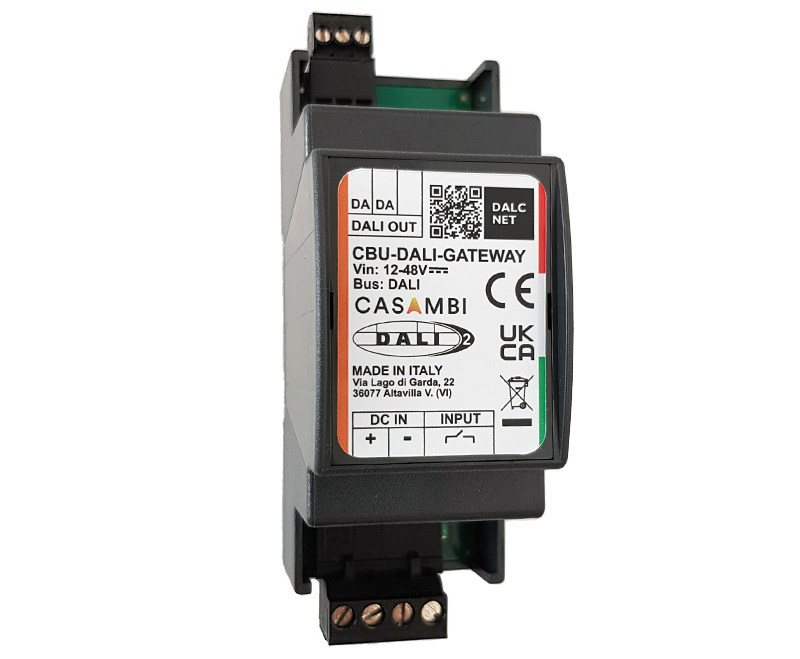
A DALI gateway extends these capabilities beyond the lighting system itself, enabling integration with protocols such as KNX, BACnet or IP-based systems. This allows a building controller, for example, to manage lighting scenes, dimming levels and energy optimization strategies from a central interface.
Through protocol conversion and data mapping, the gateway ensures that commands generated by one system are correctly interpreted and executed by DALI devices, maintaining consistency across the entire installation.
The role of a DALI gateway goes beyond simple signal translation. It is a strategic element in the transition from isolated lighting control to integrated building management.
By connecting lighting systems with external platforms, the gateway enables centralized monitoring, allowing operators to access real-time information on system status, energy consumption and device performance.
It also supports advanced lighting automation scenarios, where inputs from sensors, schedules or building logic can dynamically control lighting behavior without manual intervention.
This capability is essential in environments such as offices, airports, retail spaces and industrial facilities, where lighting must adapt continuously to operational requirements.
DALI gateways are typically deployed in projects requiring high scalability and flexibility. Since a DALI network allows precise individual and group control of luminaires, the gateway ensures that these capabilities can be extended to larger, interconnected systems.
In complex installations, multiple gateways can be used to manage different zones or integrate multiple subsystems, creating a distributed but coordinated control architecture.
Thanks to this approach, engineers can design lighting infrastructures that remain adaptable over time, without the need for major hardware modifications.
As a lighting control manufacturer, Dalcnet develops DALI gateway solutions with a strong focus on integration, reliability and engineering flexibility.
Dalcnet gateways are designed to operate as intelligent interfaces within lighting systems, enabling seamless communication between DALI networks and external platforms while maintaining high performance and stability.
The company’s development approach is based on rigorous system-level thinking, where hardware design and internal firmware development are perfectly aligned to support:
· Interoperability across standard and complex proprietary automation protocols.
· Flexible software configuration and precise register mapping of control signals.
· Exceptionally reliable operation in continuous, mission-critical environments.
This technical framework allows OEMs and system integrators to implement advanced control strategies while significantly reducing system complexity and integration risks. > Explore our DALI Protocol Converters and Interfaces
Modern buildings require lighting systems that are not only efficient, but also connected, adaptable and data-driven.
Dalcnet DALI gateway solutions are designed to meet these requirements by enabling integration between lighting and building automation systems. Through a combination of protocol expertise and R&D-driven development, Dalcnet supports the creation of scalable and future-proof lighting infrastructures.
A DALI gateway is a fundamental element in the evolution toward intelligent lighting systems.
By enabling communication between lighting networks and building-wide control platforms, it transforms lighting into an integrated, responsive and data-driven component of modern architecture.
As a specialized lighting control manufacturer, Dalcnet delivers DALI gateway technologies that support advanced system integration and long-term performance.
A DALI gateway is used to connect DALI lighting systems with other control protocols or building automation platforms. It enables centralized management and integration of lighting within a broader system environment.
A DALI gateway works by translating communication between the DALI protocol and other systems such as KNX, BACnet or IP networks. This allows commands, scenes and control signals to be exchanged between different technologies.
A DALI controller manages and sends commands within a DALI network, while a DALI gateway connects the DALI system to external control platforms or protocols, enabling system integration beyond the lighting network.
In modern buildings, multiple systems must work together. A DALI gateway enables lighting systems to integrate with HVAC, security and energy management systems, creating a unified control environment.
Yes, DALI gateways are designed to integrate DALI with other protocols such as KNX, BACnet or IoT platforms. This allows seamless communication and coordinated control across different building systems.
Using a DALI gateway improves system flexibility, enables centralized monitoring, simplifies integration and supports advanced automation scenarios in smart building environments.