Results
No exact match, try with fewer filters or a more generic term
Each pixel node contains a dedicated integrated circuit (IC) that receives data frames from an addressable led controller and executes specific electrical lighting commands independently.
The controller sends a continuous stream of data, and each pixel processes only the information intended for it before passing the remaining data along the chain.
This architecture enables:
Independent control of individual LEDs
High-resolution animations and transitions
Real-time dynamic effects across large installations
For engineers and designers, SPI technology opens up a level of control that goes far beyond traditional lighting systems.
SPI Pixel to Pixel solutions are designed for applications where lighting plays an active role in communication, interaction or storytelling.
They are widely used in architectural façades, entertainment venues, retail environments and immersive installations, where dynamic lighting effects enhance both functionality and visual impact.
In these contexts, lighting is no longer just illumination—it becomes a programmable surface capable of expressing motion, rhythm and visual identity.
A complete SPI Pixel to Pixel system is built around a set of essential components working together:
Controllers, which generate and manage pixel-level data
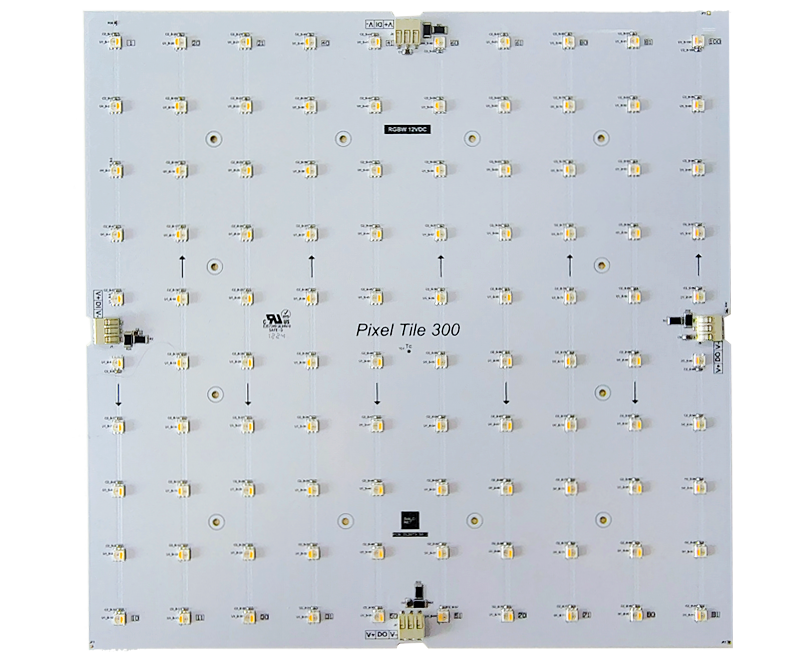
Addressable LED modules or strips, where each pixel is individually controlled
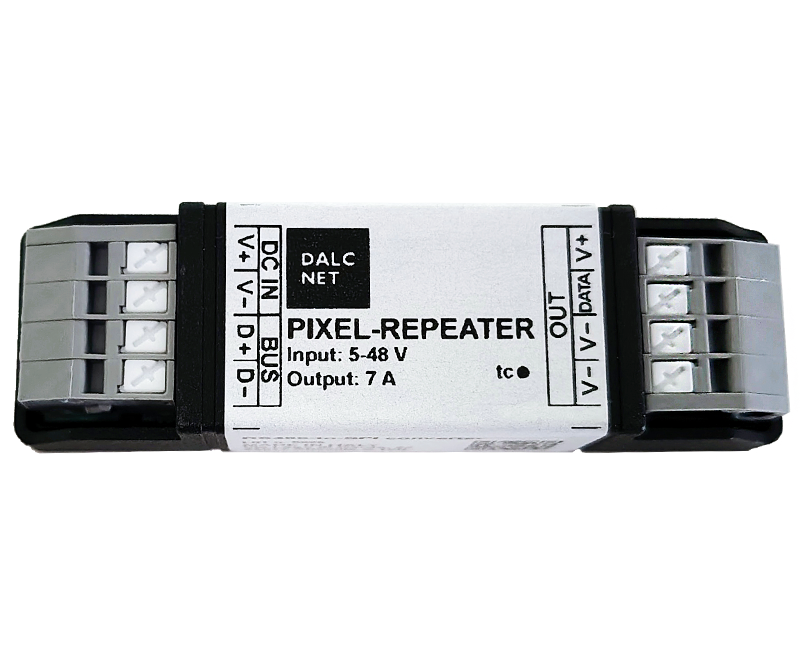
Repeaters and converters, used to extend signals and maintain performance across large installations
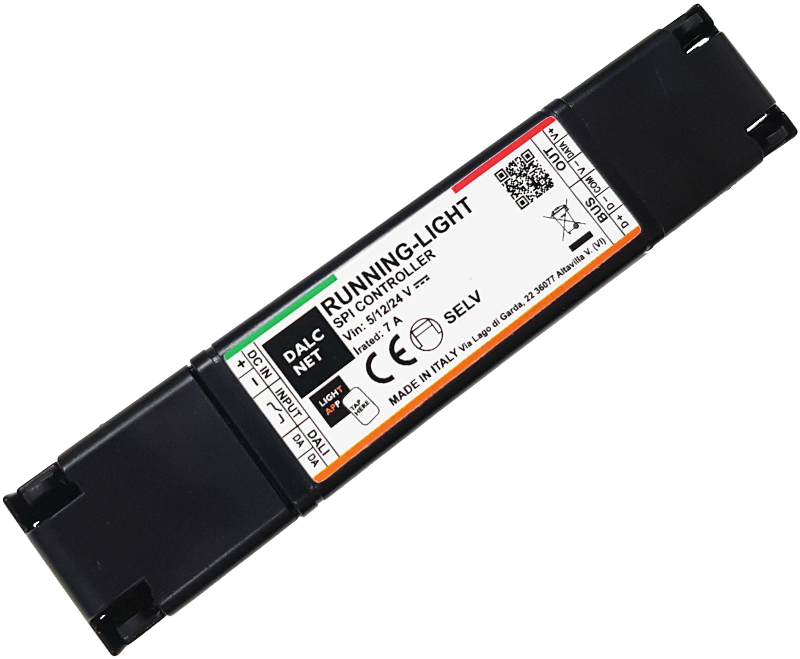
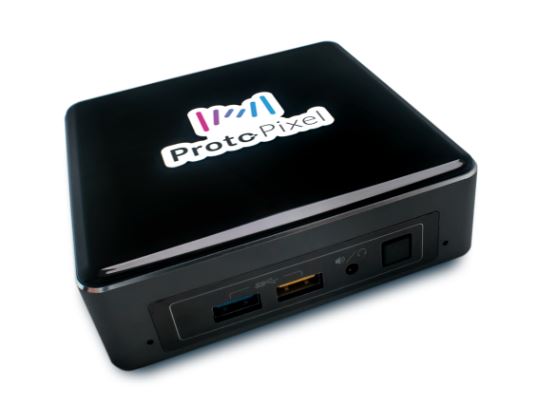
Solutions such as RUNNING LIGHT, PIXEL TILE RGBW, RUNNING LIGHT CASAMBI and PIXEL REPEATER represent different roles within this ecosystem, from control generation to signal extension and modular lighting integration.
In particular, repeater modules enable signal transmission over long distances and allow dynamic effects to be duplicated across multiple installations without loss of synchronization.
SPI systems are inherently scalable. Because data is transmitted sequentially across the pixel chain, installations can be expanded by adding more modules and segments without redesigning the entire system.
However, larger setups require careful signal management. Devices such as pixel repeaters are used to extend communication distances, ensuring consistent performance even in complex or distributed installations.
This flexibility allows engineers to design lighting systems ranging from small decorative elements to large architectural façades and media installations.
As a lighting control manufacturer, Dalcnet develops SPI Pixel to Pixel solutions with a strong engineering focus on reliability, flexibility and integration.
Dalcnet’s ecosystem includes advanced controllers and complementary modules designed to work together seamlessly:
SPI controllers for pixel-by-pixel LED control
Casambi-enabled solutions for wireless configuration and management
Repeater modules to extend system architecture and maintain signal integrity
Solutions such as RUNNING-LIGHT-CASAMBI allow configuration of dynamic lighting effects—including speed, color, direction and sequencing—via mobile applications, while maintaining precise control at the pixel level. This integrated approach enables designers and system integrators to develop sophisticated lighting systems without compromising usability or performance.
SPI Pixel to Pixel technology sits at the intersection of lighting engineering and creative design.
It requires a deep understanding of signal management, power distribution and control architecture, while offering unprecedented freedom in visual expression.
Dalcnet solutions are designed to support both aspects—providing robust hardware platforms for engineers and flexible tools for designers working with dynamic lighting applications.
SPI Pixel to Pixel lighting represents the evolution of LED control—from static illumination to fully programmable, dynamic systems.
By enabling precise, individual control of every pixel, it transforms lighting into a digital language capable of shaping spaces, experiences and identities.
As a specialized lighting control manufacturer, Dalcnet develops solutions that bring this technology into real-world applications, supporting scalable and high-performance lighting architectures.
SPI Pixel to Pixel lighting is a digital LED control system where each LED or group of LEDs can be individually addressed and controlled, allowing for dynamic effects and animations.
SPI control works by sending serialized data from a controller to each pixel in sequence. Each LED reads its specific data and passes the remaining signal to the next pixel in the chain.
Standard LED strips display the same color along the entire length, while pixel LED systems allow individual control of each LED, enabling animations, gradients and dynamic effects.
A pixel repeater is used to extend the control signal and replicate lighting effects over long distances, ensuring consistent performance across large or distributed installations.
Yes, solutions like RUNNING-LIGHT-CASAMBI integrate SPI pixel control with wireless technologies, enabling configuration and control via Bluetooth-based applications.
They are used in architectural lighting, entertainment, retail, media façades and immersive installations where dynamic visual effects are required.
SPI systems provide maximum control, scalability and flexibility, enabling complex lighting effects and high-resolution visual experiences in both small and large installations.